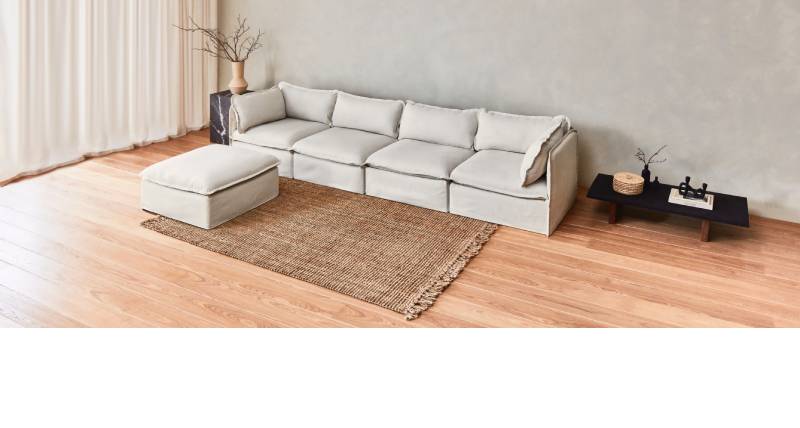


How to Style Sofas of Different Sizes in Your Space
Picking the right sofa size feels impossible sometimes. Your room's a certain size, you've got specific needs, and sometimes the furniture you love just doesn’t quite fit - either too big or a little too small. The thing is, styling sofas successfully isn't about finding one perfect piece. It's about understanding how different sizes work in your actual space (not the imaginary Pinterest version of your space).
I’ve seen so many people run into issues with sizing. They’ll fall in love with an oversized sectional that can’t even make it through the doorway, or they’ll choose a piece that ends up looking too small for the room, leaving the space feeling empty and unfinished. Below are some helpful tips on choosing the right size and styling your sofa to suit your space.
Understanding Sofa Sizes and What They Actually Mean
The Standard 3-Seater Sofa
A typical 3-seater sofa usually measures between 78" and 90" in length, making it a comfortable fit for most standard living rooms. It’s a popular choice because it works well for couples, small families, and casual gatherings—perfect for everyday living. Generally, this size feels right in rooms around 12' x 14' or larger.
Anabei’s 3-seater runs a bit more generous, with widths up to 103". The extra size adds depth and lounging comfort, making it ideal for both upright seating and stretching out. The key is to choose the size that fits how you truly live—not just what’s considered “standard.”

Photo by Hannah Jansman - Modular Washable 3-Seater Sectional in Eggshell | Memorix+ Seat | Contour Pillow
Compact Options for Tight Spaces
The Solo 1-Seater Sofa
Technically, a 1-seater sofa is basically an oversized armchair. They run 30 to 40 inches wide and are perfect for reading nooks, office spaces, or bedroom corners. Not everything needs to be about maximum seating capacity (sometimes you just want one really good spot that's yours).
Two-Seater Sofa
A 2-seater sofa typically measures between 60" and 72" wide, making it a perfect fit for apartments, smaller condos, or as extra seating in larger living rooms. It’s not about compromise, it’s about choosing the right scale for your space. In a smaller room, a well-sized 2-seater feels intentional and thoughtfully placed, while an oversized sofa can dominate the space and throw off the balance of your layout
These also work great as companion pieces. Pair one with a 3-seater sofa into an L-arrangement and suddenly you've got flexible seating that doesn't lock you into one rigid configuration (life's too short for furniture you can't rearrange).
Going Bigger With Multi-Seaters
The Versatile 4-Seater Sofa
A 4-seater sofa stretches to about 100 to 140 inches, great for families or people who host regularly. These work best in rooms that are at least 14' x 16'; in anything smaller, the space can start to feel crowded instead of comfortable.
In larger rooms, a 4-seater shines when floated in the center, helping define separate living and dining zones in open layouts. Just be sure to leave at least 30 inches of clearance for walkways (your shins will definitely appreciate it).

Modular Washable 4-Seater U-Sectional in Eggshell | Deluxe+ Seat | Cloud Pillow
The Family-Sized 5-Seater Sofa
A standard 5-seater sofa typically measures around 100–108 inches and requires serious space, ideally a room at least 16' x 18' to avoid overwhelming the area. It’s perfect for big families who actually use all that seating or homes that host game nights and holiday gatherings regularly.
If you opt for a modular sofa that allows corner or L-sectional layouts, these dimensions can vary, giving you more flexibility to adapt the seating to your space.
You’ll want to position a 5-seater as the main anchor piece, with smaller chairs or ottomans as supporting elements. With the right proportions and a quick check of your measurements, it can create a welcoming, well-designed room that feels both spacious and inviting.
Must Checkout: Apartment Living Room Ideas: Making Your Small Space Actually Feel Like Home
Large Modular Sofas: 6 to 9-Seater Options
Now we’re talking serious seating. A 6-seater sofa runs 110+ inches, a 7-seater pushes 120+ inches, and 8- and 9-seater options are essentially full sectionals at this point. Honestly, at this size, modular sectionals make way more sense, since you can actually move and rearrange them as needed.
These larger sofas shine in:
-
Spacious basement rec rooms
-
Large family rooms that regularly host crowds
-
Open-concept rooms that need substantial furniture
-
Homes where six or more people live and everyone needs a spot
For a standard living room, though? You might be going a bit overboard. In a typical living room, a 6-seater can easily overwhelm the space and feel out of proportion.

Photo by Lisa Song - Modular Washable 7-Seater Open-Ends U-Sectional + Ottoman in Mist | Memorix+ Seat | Contour Pillow
Styling Tips by Room Size
Small Living Rooms (Under 200 sq ft)
What Works:
-
Stick with a 3-seater sofa at most, or pair a 2-seater with a couple of accent chairs
-
Consider a 1-seater for reading corners
-
Choose armless designs to save visual space
-
Lighter colors help the room feel open and airy
What Doesn’t:
-
Anything labeled as a 4-seater or larger
-
Deep-seated sofas that dominate the floor
-
Bulky arms that add width without adding functional seating
Medium Spaces (200–300 sq ft)
This is the sweet spot for a standard 3-seater sofa. You have room to add accent chairs or an ottoman without feeling cramped. If you have modular configurations, you can even connect a 2-seater and a 3-seater into an L-shape for more flexible seating and a layout that adapts to your space.
A 4-seater works here too if you keep other furniture minimal. Position it toward your main focal point; TV, fireplace, or a beautiful window and angle chairs to create inviting conversational areas rather than lining everything up theater-style. This makes the room feel more dynamic and functional.
Large Rooms (300+ sq ft)
Now you have the freedom to get creative. A five-seater sofa can anchor the space without overwhelming it, or two 3-seaters facing each other create a stylish, symmetrical layout - perfect if a TV isn’t dictating the room.
Bigger spaces can easily accommodate 6- or 7-seater sofas. Technically, you could fit an 8- or 9-seater, but at that point, modular sectionals are likely the better option. The key in large rooms is leaving enough open space so the layout feels balanced - more furniture isn’t always better, even if your brain says otherwise.
Layout Strategies That Actually Work
The Classic L-Shape
Most common for good reason. Your 3-seater sofa goes along the main wall, add a 2-seater sofa or loveseat perpendicular to it. Creates a natural conversation zone, defines your living area in open concepts, just works (sometimes the classics are classic for a reason).
For bigger spaces, try a 4-seater sofa with a 3-seater sofa perpendicular, or even a 5-seater sofa as your main piece with a 2-seater sofa completing the L.
Facing Sofas for Drama
Two sofas facing each other look elegant and encourage conversation. Works best with matching sizes like two 3-seater sofas or a 4-seater sofa paired with a 2-seater sofa. Throw a coffee table between them and you've got that designer showroom vibe (but livable).
Just make sure there's 30 to 36 inches between them. Too close can feel awkward, too far apart, and people are shouting across the void to talk.
Floating Arrangements
If you've got the space, float your 3-seater sofa, 4-seater sofa, or even a 5-seater sofa away from the walls. Use it to divide open floor plans into distinct zones. Feels sophisticated and makes huge rooms feel more intimate (instead of echoey and empty).
Works particularly well with larger pieces like a 6-seater sofa or 7-seater sofa, where you add a console table behind for lamps and decor. Suddenly, that awkward back-of-sofa view becomes an intentional design element.
Color and Style Considerations
Matching vs. Mixing
You don't need your 2-seater sofa and 3-seater sofa to match perfectly. Coordinate them through shared elements like leg style, similar tones, or complementary fabrics. Too matchy-matchy can look catalog-boring (lived-in spaces have personality).
That said, if you're mixing sizes like a 3-seater sofa with a 5-seater sofa or 6-seater sofa in the same room, keeping them in the same style family helps everything feel cohesive instead of random.

Photo by Eva Catherine Chicollo - Modular Washable 5-Seater Corner Sectional + Ottoman in Oat | Deluxe+ Seat | Cloud Pillow
Scale and Proportion
Big rooms need bigger pieces, or they look lost. Small rooms need appropriately scaled furniture, or they look stuffed. A giant 7-seater sofa in a tiny apartment is trying too hard. A small 1- or 2-seater sofa tends to get lost in a spacious loft.
Anabei’s collections are thoughtfully designed with proportion in mind, offering modular and washable pieces so you can choose furniture that fits your space perfectly without sacrificing style or quality.
Practical Tips Before You Buy
Measure Everything Twice
Your room, your doorways, your stairs, your elevator, if you've got one. Most 3-seater sofas fit through standard 32-inch doorways, but a 4-seater sofa, 5-seater sofa, or anything bigger might need creative maneuvering (or taking apart, which not all sofas allow).
Use painter's tape on your floor to map out the actual footprint. Live with those tape lines for a few days. Walk around them. Make sure the layout actually flows before you invest in a new piece.
Think About Your Real Life
An 8-seater sofa or 9-seater sofa sounds great until you realize you have like four people over max twice a year. A small 1-seater sofa seems fine until you remember you need actual seating for your family. Be honest about your actual daily life, not your aspirational lifestyle (your furniture budget will thank you).
Making Your Final Decision
The best sofa size for your space comes down to room dimensions, daily use, and personal preference. A 3-seater sofa works for most situations because it's genuinely versatile. But if you've got a small apartment, don't force it. In a large family room, don’t shy away from plenty of seating—embrace it fully.
Anabei's range covers everything from a 2 seater sofa to larger configurations, such as a 6- seater up to 9- seater options. Quality materials, flexible sizes, styles that work in actual homes instead of just magazine spreads.
Measure your space, think through your needs, and pick accordingly. Your living room should work for how you actually live, not how furniture designers imagine you live.
FAQs:
1) Can different sofa sizes work in the same room?
Yes. Balance the visual weight, use a consistent color palette, and ensure enough spacing between pieces. Mix sizes only if the layout supports flow.
2) How much space should I leave between sofas?
Leave 18–24 inches between sofas and a coffee table, and 30–36 inches for walkways to keep movement comfortable.
3) How do I match a big sofa with a small one?
Use matching fabrics, similar leg styles, and coordinating cushions to keep the look cohesive. Anchor with a large rug that ties everything together.
4) Should all sofas match?
Not necessarily. They should complement each other in color, scale, and style while fitting the room layout.