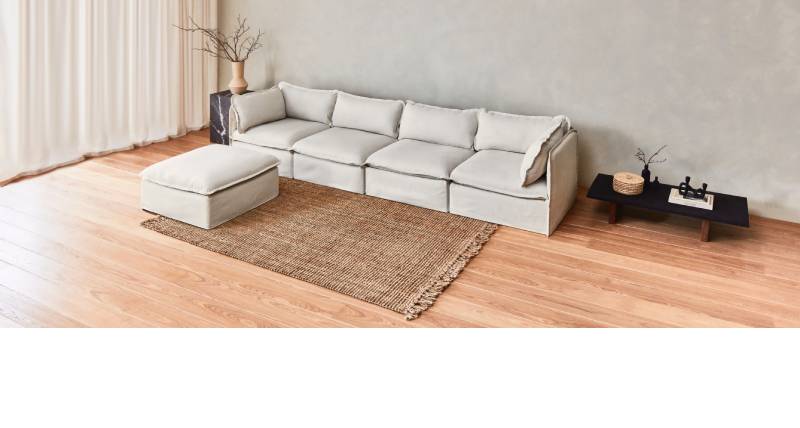


Why Modular Sectional Sofas are Perfect for Small Living Rooms
Small space living doesn't mean you're stuck with uncomfortable seating. A good modular sectional sofa can completely change how your cramped apartment feels. I've watched friends transform their tiny studios just by swapping out their rigid furniture for pieces that actually work with limited space (instead of fighting against it the whole time).
Finding sectionals isn't hard. Finding ones that actually fit without making your place feel like a furniture warehouse? That's the real challenge.

Modular Washable 3-Seater in Powder | Memorix+ Seat | Contour Pillow
Why Modular Sectional Sofas Just Work Better
You Can Actually Rearrange Them
Traditional sectionals tend to be more limiting, as they are fixed, cannot be changed, not modular, or washable. Once you commit to that L-shape, you're stuck with it until you move or give up entirely. A modular sofa sectional allows you to rearrange the layout however you want, which is huge when your living room is already pushing its limits.
Got an odd radiator in the corner? Work around it. Want to flip your setup for movie night versus having people over? It takes a couple of minutes. Moving next year to a place with a totally different layout? Your sofa moves with you instead of becoming that next item you're desperately trying to sell on Facebook Marketplace (we've all seen those posts).
Sofas That Grow With You
Maybe right now it's just you and maybe a roommate. Next year, you might move into a bigger place, and your sofa needs will grow along with it. Modular sectionals let you buy more pieces later without starting from scratch.
Three modules work fine in a studio. Add another when you move up to a one-bedroom. Eventually, get a whole house and expand to six pieces. Same furniture family, just growing along with your life.

Modular Washable 3-Seater Sectional in Ash | Memorix+ Seat | Contour Pillow
What Separates Great From Good
A Well-Built Sofa
Inexpensive modular sectionals often look good at first- but six months in, the flaws start to show. Connections loosen, frames creak, and cushions flatten or lose their shape entirely. Anabei is designed with features that survive real life, kids bouncing around, pets thinking they own the place, and everyday wear and tear.
Solid steel frames are non-negotiable, as are reinforced connection points between modules. High-density foam maintains its shape over time, instead of turning into those sagging cushions that need constant fluffing (you know the kind).
Must Read: Dining Room Ideas: Stylish, Functional & Inspiring Designs for Every Home
Must-Have Sofa Features That Make a Difference
-
Fully modular seating that lets you rearrange layouts or add pieces over time, so your sofa can grow and adapt with you
-
High-resilience foam that holds its shape and resists sagging, designed for long-term comfort
-
High-performance fabrics that are easy to clean when life gets messy, including liquid- and stain-resistant, pet-friendly, washable, commercial-grade options
-
Arms designed to maximize seating space, so you’re not losing room to bulky frames
-
Reversible cushions that rotate for even wear and longer life
-
Built-in storage within ottoman pieces, offering smart solutions for small spaces
-
Quick, simple assembly with no expensive or complicated tools required
-
Sustainability-conscious options: If eco-friendly features matter to you, look for sofas with CertiPUR-US® certified foam and fabrics that are PFC/PFAS-free and OEKO-TEX® certified
Sofas That Fit Real Apartments
Anabei’s sofas are intentionally built for how people actually live in apartments - not oversized layouts meant for formal living rooms. With slimmer arms that maximize seating space and modules measuring 34 inches deep, each piece is scaled to fit smaller rooms without crowding them. These pieces are sized to fit comfortably in spaces as compact as 10 × 12 feet, while modular components allow you to rearrange, add seating, or adapt your layout over time. The result is a sofa that uses space efficiently, offers flexibility as your needs change, and still delivers everyday comfort and style.
How to Choose the Perfect Sofa Configuration for Your Space
L-Shape Sectionals
The classic L-shape is a timeless, versatile layout that works in almost any room. It delivers generous seating without interrupting the natural flow of the space. Most modular L-sectionals are created by pairing a standard sofa with an attached chaise lounge or ottoman, and can be configured left- or right-facing depending on your wall layout. These setups typically use three to five modules, based on how many people you want to seat.

Modular Washable 3-Seater Sectional in Milk | Memorix+ Seat | Contour Pillow
Corner Sectionals
Corner sectionals are designed to nest neatly into a corner, maximizing seating while keeping walkways clear. This layout gives you more flexibility to anchor the rest of the room, whether that means adding a coffee table or creating a central gathering area. Because they prioritize seating capacity, corner sectionals traditionally work best in larger spaces and usually require three to five modules.
That said, with fully modular units like those from Anabei, you can scale down - even a 3-seater corner sectional works beautifully in smaller rooms, giving you the benefits of a corner layout without overwhelming your space.
And that corner seat where the two sides meet? It’s always the most coveted spot. You’ve been warned!
U-Shaped Sofa Layouts for Maximum Seating
Sounds insane for a small space, right? Actually, U-shaped sectionals work beautifully in open layouts or studios, where the sectional helps define your living zone. Typically, they take 5 to 7 modules and create a cozy, enclosed seating area that doesn’t feel cramped, if you do it right.
Just make sure the open end faces whatever you’re looking at most, whether it’s a TV, a window, or a view you love. You’ll ideally need at least 12×14 feet of space, otherwise you risk blocking walkways.
For smaller rooms, Anabei even offers a 3-seater U-shaped sectional, giving you that same cozy, defined layout in a more compact footprint.
Linear Sofa Arrangements for Unconventional Rooms
Sometimes, simple wins. Line up 3 to 4 modules along your longest wall and place an armed piece on each end. You get plenty of seating in a minimal setup that works when L- or U-shaped layouts would just get in the way.
This also works amazingly as a room divider in studios. Creates a little separation between where you sleep and where you live without building actual walls.
How to Select Fabrics and Colors That Last
Fabrics That Handle Real Life
Performance fabrics resist stains but still feel soft. You can actually relax without hovering over every drink like it's a bomb (exhausting way to live). Lots of options now have covers you can just throw in the washing machine, which is honestly the best thing ever for any sectional sofa for small space situations.
Velvet looks fancy but doesn't take up visual space. Linen breathes nicely all year. Microfiber holds up pretty well (just make sure you're getting decent quality, not bottom-barrel stuff).

Modular Washable Ottoman in Rust | Memorix+ Seat
Color Choices That Help
Light neutrals brighten a space by reflecting natural light, making rooms feel open and airy. They create a clean, timeless backdrop and pair effortlessly with almost any décor. Shades like soft grays, warm beiges, and gentle blues serve as versatile bases that stay fresh and appealing over time. However, you do want to be mindful that when it comes to pet hair or stains it can be more visible than darker colors.
Darker colors offer a rich, cozy feel and naturally minimize the appearance of everyday wear. A charcoal or navy modular sectional sofa can bring depth and sophistication to a smaller room, helping it feel grounded and intentionally styled.
Sofa Pricing Guide
Options Under $1,500
Modular sectional sofas in this range typically start around $800 to $1,500 for a 3-piece set. At this price point, most options feature straightforward frames and standard foam - nothing flashy, but well suited for light everyday use, guest rooms, or first apartments. Selection is more streamlined, with minimal customization available. Quality can vary widely,
With flexible fabric and comfort options, Anabei makes customization accessible at a competitive price.
Middle Ground $1,500 to $3,000
This is the sweet spot. Way better construction without going full luxury. Stronger frames, nicer fabric, foam that doesn't turn into pancakes. Sofas at this level usually last 5 to 8 years of actual regular use.
You start seeing removable covers, reinforced corners, and connection systems that don't feel sketchy. Your sectional sofa for a small space gets real upgrades that make daily life better.
Going All In $3,000+
Top-shelf modular sectional sofas use premium everything. Frames are guaranteed forever, basically. Cushions filled with down blends that stay fluffy and you can customize however you want.
Makes sense if you're staying put for a while and want furniture that actually lasts. When something survives 15+ years, that cost per year drops way down.
Delivery and Setup Details
Measure Your Doorways First
Modular sofas are designed to make delivery easier, but packaging can still vary by brand so it’s always smart to measure your doorways ahead of time. For anyone living in a small apartment or dealing with narrow entryways, this can be a real concern. Anabei keeps that in mind by designing packaging specifically to fit through standard doors.
From air-compressed seating to collapsible frames, every detail is thoughtfully engineered to move easily from one home to the next - even as doorways and layouts change over the years. The modules are under 36 inches wide, making standard doorways a non-issue.
And that’s the real advantage of modular sectionals for small spaces: if something doesn’t fit, you simply take it apart. No removing doorframes, no hiring specialty movers - just a far less stressful move all around.
Assembling It Together
Good modular systems don't need tools. Most use intuitive clips, brackets, or durable fasteners that allow the pieces to click together securely with minimal effort. Even big setups usually take like 20 to 30 minutes tops.
Try the connections in the store if you can, or at least check that you can return if the pieces feel wobbly when you get them home.
Choose What Works for You
The best modular sectional sofa for your tiny living room comes down to what fits your actual life and budget. Stop looking at those Pinterest boards that show 2000 square foot lofts pretending they're "small space solutions" (they're not, trust me).
Anabei designed a collection that actually delivers on being modular. Modules that rearrange easily, survive real use, and adjust when your life changes. Good materials, smart designs, configurations that respect the fact that small spaces have real limitations.
Measure everything twice, think about how you actually move through your space, and be honest about your daily routines. The right choice makes your cramped place feel surprisingly workable and comfortable instead of like you're constantly fighting your furniture.
FAQs
1. How do I choose a modular sectional for a small living room?
Choose a compact modular sofa with reversible sections, armless units, and storage options. Measure your room, leave 30–36 inches for walkways, and pick light colors or low-profile designs to keep the space open and flexible.
2. Are modular sectionals good for small apartments?
Yes. Modular sectionals are ideal for small apartments because you can rearrange, split, or add pieces based on your layout. They maximize seating without crowding the room and adapt to tight or awkward spaces.
3. What shape sectional works best in a small room?
U-shaped modular sectionals work best because they utilize corner space efficiently. Choose slim arms, raised legs, or chaise modules to keep the room feeling open.
4. What size modular sofa fits a small living room?
Look for 70–95 inches in width depending on your room size. Always leave at least 18–24 inches of clearance around furniture for comfortable movement.