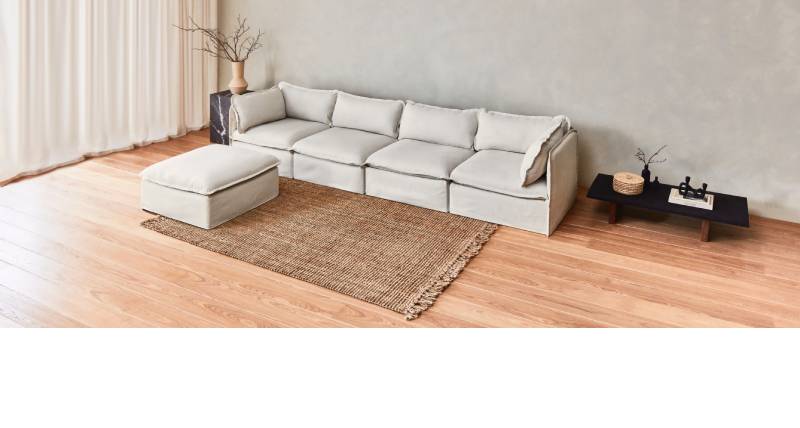


What is the Difference Between a Sectional Sofa and a Modular Sofa?
Sofa terminology is often used loosely, but the distinctions matter. “Sectional” and “modular” are frequently treated as interchangeable, yet they describe fundamentally different levels of flexibility and long-term adaptability. Understanding this difference from the outset helps ensure the sofa you choose continues to work for your space well beyond the initial purchase.

Modular Washable 2-Seater in Coco | Memorix+ Seat | Contour Pillow
What Are the Different Types of Sofas Available?
A sectional sofa is a large seating piece made up of two or more connected sections that together form a specific shape, typically an L or U configuration. The sections are usually designed to work as a fixed set, meaning the layout is determined at the point of purchase and stays that way. Sectionals are sold as complete units and are not typically intended to be broken apart or rearranged.
A modular sofa, by contrast, is built from individual units that can be connected in any combination. Each module, whether an armchair, armless chair, corner piece, or ottoman, functions as a standalone piece that also connects to others using fasteners or clips. The layout is not predetermined. A modular washable sofa can be a 2-seater today, a corner sectional next month, and a U-sectional when a bigger space becomes available.
Beyond these two, the broader sofa category includes standard sofas, loveseats, open-end configurations, and chaise setups, all of which sit in a spectrum between fixed and flexible depending on how they are constructed.
What Factors Should You Consider When Choosing a Sofa?
The most practical question is how permanent the setup needs to be. For someone who moves often, lives in a rental, or simply likes changing how a room feels without buying new furniture, a modular washable sofa offers considerably more value than a fixed sectional.
Room size and layout matter enormously. Fixed sectionals commit a room to one configuration. If the room layout changes, if a wall gets repainted and the sofa no longer works with the color, or if a move requires fitting the sofa into a differently shaped room, a traditional sectional creates a problem that is expensive to solve. Modular systems sidestep this entirely.
Maintenance is also worth factoring in early rather than after the sofa arrives. Fixed upholstery that cannot be removed or properly cleaned deteriorates visibly in high-use households. Anabei’s modular washable sectional sofa offers a fully removable and machine-washable cover that removes that limitation entirely, which matters most in homes with children, pets, or anyone who uses the sofa heavily every day.
How Do Popular Sofa Types Compare to Each Other?
A traditional sectional sofa tends to offer a seamless, unified aesthetic. Because the pieces are designed as a set, the proportions and fabric are consistent across the whole unit. The tradeoff is that the layout is locked in. Most sectionals cannot be meaningfully reconfigured, and if one section wears out or gets damaged, replacing just that part is rarely possible.
A modular designed sofa prioritises flexibility over fixed form. Individual modules connect using fasteners, meaning the layout can shift from a straight sofa to a corner sectional to a full U-shape without tools. If a module wears out, it can be replaced independently without affecting the rest of the sofa.
Anabei's collection is built on this modular system. Every unit connects to the next using the same fastener logic, and the range spans from 1 to 9 seaters, covering sofas, loveseats, corner sectionals, U-sectionals, and open-end configurations. The same patent-pending powder-coated steel frame runs across the entire collection, meaning modules can be combined and swapped across configurations over time.

Modular Washable 2-Seater in Chestnut | Memorix+ Seat | Contour Pillow
What Are the Pros and Cons of Each Sofa Type?
The main advantage of a traditional sectional is simplicity at the point of purchase. One decision covers the whole seating setup. The downside is inflexibility after that decision is made. Fixed upholstery ages, layouts cannot change, and delivery into tight spaces is often complicated because the pieces do not break down into manageable sizes.
The advantage of a modular sofa is that it compounds over time. The sofa that is bought today can grow or shrink as needs change. Additional modules can be added, the layout can shift with the room, and covers can be swapped when style preferences change. The washable modular sofa specifically adds another layer of practicality, because the ability to machine wash the covers and frame duvet means the sofa stays genuinely clean rather than just surface-wiped.
Anabei ships each module in easy-to-manage lightweight boxes that fit through any standard door. Assembly takes under five minutes: arrange the frame, slip on the washable duvet, and dress with the performance covers.
How Can You Choose the Right Sofa for Your Home?
Start with how permanent the decision needs to be. If the living situation is likely to change within a few years, a modular washable sectional sofa that adapts to new rooms and layouts is a more sensible investment than a traditional sectional that may not fit the next space.
Consider the household, too. The best modular sofas for active households are ones where the fabric can be properly cleaned. Anabei's performance fabrics are liquid and stain-resistant with a nontoxic moisture barrier, durability tested to up to 100,000 double rubs, and PFC and PFAS-free with Oeko-Tex® certification. Both the fabric slipcovers and the internal Frame Duvet are machine washable, and the covers are fully interchangeable across 16 fabric color options and 8 upholstery types. Comfort is also customizable, with a choice between the Deluxe+ Blend for a sink-in feel or the Memorix+ contoured memory foam option. The collection starts at $699 with free shipping and a 30-day risk free return.

Modular Washable 3-Seater in Sakura | Memorix+ Seat | Contour Pillow
FAQs
1. Can a modular sofa be rearranged like a sectional?
Yes, and that is one of the core advantages of choosing modular over a fixed sectional. Anabei's modules connect using fasteners beneath each unit, meaning any piece can attach to any other. The layout can be changed from a straight sofa to a corner configuration to a U-shape without dismantling anything permanently.
2. Which is better for small spaces, a sectional or a modular sofa?
A modular sofa tends to work better in small spaces because it can be configured to fit the room precisely rather than being locked into a predetermined shape. A compact corner configuration uses floor space more efficiently than two separate pieces, and additional modules can be added later if the space changes.
3. Are modular sofas more expensive than sectional sofas?
Not necessarily. The price range for both is wide. A well-made modular sofa that adapts over the years and does not need to be replaced when a room changes tends to offer better long-term value than a traditional sectional purchased at a similar price. The ability to replace individual modules or slipcovers rather than the whole sofa also reduces the long-term cost of ownership.
4. Can I add pieces to a sectional sofa over time?
Traditional sectionals are generally not designed to accept additional pieces over time. Modular sofas are built specifically for this. Anabei's individual modules are available separately, which means the configuration can expand from a 3-seater to a 5-seater or beyond as needs change, using the same frame system and the same fabric collection throughout.