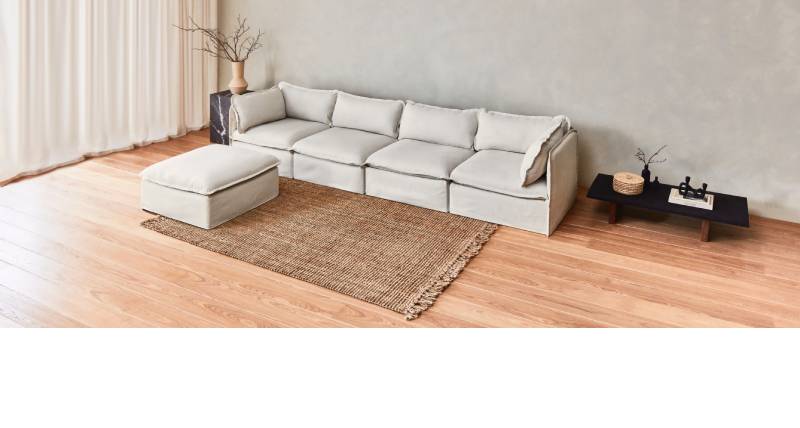


Why U-Sectionals Are Perfect for Large Family Rooms
Large family rooms need furniture that can handle crowds, feel comfortable, and still look good. A U-sectional does all three. This style of seating wraps around to create a natural spot where everyone can sit, talk, and relax without feeling cramped or sitting too far apart. (The tricky part with big rooms is making them feel cozy instead of empty, and U-sectionals really fix that problem.)
For families who use their living space for everything from movie nights to game days to just hanging out, a U-sectional gives you both the seating and the comfort you need for everyday life. This guide explains why U-sectionals work so well in large family rooms and how to pick the right one.

Modular Washable 4-Seater U-Sectional in Eggshell | Memorix+ Seat | Contour Pillow
What Is a U-Sectional?
A U-sectional is a big sofa shaped like the letter U. It usually has a center part with extra seating stretching out on both sides, creating three connected sides of seating that face inward toward the middle of the room.
Unlike L-shaped sectionals that only go in one direction, U-sectionals wrap around to give you seating on three sides. This design creates a contained seating area that naturally gets people talking and hanging out together.
Most U-sectionals come in multiple pieces that snap together. This makes it easier to move through doorways and lets you adjust things if you need to. Some U-sectionals have extra features like built-in storage, cup holders, or sections that recline.
U-sectionals come in different sizes. Smaller ones might fit six people comfortably, while bigger ones can hold eight, nine, or even more. Brands like Anabei offer modular washable U-sectionals in a range of sizes, starting with a 3-seater and up to 9-seaters so families can choose the configuration that fits their space perfectly.
Benefits of U-Sectionals in Large Family Rooms
U-sectionals have several real benefits that make them work great for big family spaces.
They anchor big rooms. Large family rooms can feel empty or weird without a big furniture piece to ground everything. A U-sectional gives you that anchor point, creating a clear seating area that shows what the room is for.
Everyone faces everyone. The U-shape naturally puts people so they can see and talk to each other easily. This works great for family chats, game nights, or watching movies together when people want to actually interact.
They use space well. U-sectionals are big, but they actually use floor space smartly by packing lots of seating into one spot. Instead of spreading separate sofas and chairs around the room, a U-sectional puts all the seating together.
They work on different activities. Families use living rooms for tons of things. A U-sectional handles all of it, whether you're having guests over, watching TV, kids doing homework, or just everyone doing their own thing in the same space.
They make big spaces feel cozy. Large rooms can feel cold or unfriendly. The wrapped-around feeling of a U-sectional makes the seating area feel warm even when the room itself is huge. (This matters a lot when you want a big room to still feel like a comfortable place to hang out.)
Maximizing Seating Capacity and Comfort
One of the biggest reasons families pick U-sectionals is how many people can sit on them.
A regular U-sectional fits six to eight people comfortably, with bigger ones holding even more. This means you don't need extra chairs or furniture that would mess up the room. When people come over, there's already plenty of space for everyone.
Comfort matters just as much as how many people fit. Look for U-sectionals with good cushion depth and back support. Seats should be deep enough for comfortable sitting, but not so deep that shorter family members struggle to reach the backrest.
Think about how firm the cushions are. Softer cushions feel nice at first, but might not support you well for long sitting. Firmer cushions provide more support but can feel a bit stiff at first. Medium-firm cushions often strike the perfect balance for everyday family use.
Many U-sectionals have different seating options within the same piece. Some sections might recline, while others stay put. Some have chaise lounges for stretching out. This variety lets different family members use the sectional in ways that work for them.
Anabei's U-sectionals have customizable cloud-like comfort made of high resilience foam - solving the common problem of finding sectionals that stay comfortable through hours of daily family use.
Best Layouts for Large Family Rooms
Where you put a U-sectional really changes how well the room works.
Centered in the room works when the family room is big enough to walk all the way around the sectional. This creates a conversation area in the middle and lets you get to it from all sides. It works really well in rooms where the TV is on the wall, and you can see it from the sectional's open end.
Place one side of the U against a wall, leaving the other two sides open. This uses space better in rooms that are big but not massive. It also creates a more protected, cozy feeling while still giving you lots of seating.
Floating in front of windows can work when the windows are high on the wall. This uses natural light while still using the sectional to show where the seating area is. Just make sure the sectional back doesn't block too much light or obstruct the view.
Facing a focal point means setting up the U-sectional so the open end faces the room's main feature, whether that's a fireplace, TV, or big windows with a view. This creates a natural setup where everyone sitting can enjoy that main feature.
Leave enough space around the U-sectional for people to move comfortably. At least 30 to 36 inches of clearance on the open sides lets people walk around without feeling cramped.

Photo by Karissa Jaminski - Modular Washable 6-Seater Open-Ends U-Sectional + Ottoman in Mist | Memorix+ Seat | Contour Pillow
Choosing the Right Size and Configuration
Getting the size right makes sure the U-sectional fits both the room and what your family needs.
Measure the room carefully before you shop. Write down how long and wide the space is where the sectional will go. Don't forget about doors, windows, and other furniture that's staying in the room.
Use painter's tape to mark where the sectional will sit on the floor. This shows you how much space it'll really take up and whether it leaves enough room to walk around.
Think about how deep the sectional is, not just how long. Deep sectionals give you more lounging space but stick out further into the room. Regular sectionals are usually 36 to 40 inches deep, while deeper ones can go up to 45 inches or more.
Think about configuration options. Some U-sectionals are the same on both sides. Others have one longer side. What's right depends on your room shape and how your family will use the space.
Modular U-sectionals, like the ones from Anabei, give you flexibility because you can rearrange the pieces. This matters if you move or want to change the room layout later.
Materials and Fabrics for U-Sectionals
What your sectional is made of affects both how it looks and how practical it is in a busy family room.
Performance fabrics fight off stains, moisture, and wear better than regular upholstery. These fabrics make sense for families with kids or pets. Look for materials that are stain-resistant or easy to clean.
Leather and faux leather wipe clean easily and get a natural look over time. Real leather costs more but lasts longer. Faux leather offers a similar look for a lower price, but it may not be as durable over time.
Microfiber feels soft and fights stains pretty well. It's also usually cheap. But microfiber can show wear spots in areas that get used a lot over time.
Washable slipcovers make cleaning much easier.
Anabei specializes in machine washable sectionals with machine performance fabric slipcovers that can be fully removed and washed. This feature is especially valuable in family rooms that see heavy daily use, spills, and everyday messes.
Color plays an important role in large family rooms. Darker shades tend to hide stains and everyday wear more easily, though they can sometimes make large furniture feel heavier in the space. Lighter colors help brighten a room and create a more open feel, but they may require more frequent cleaning. Medium tones often offer the best balance between practicality and visual appeal.

Styling Tips for Large Spaces
A U-sectional needs smart styling to look like you meant it instead of just being too big.
Use an area rug to show where the seating area is. The rug should be big enough that at least the front legs of the sectional sit on it. This grounds the furniture and makes all the pieces look connected.
Add different textures with throw pillows and blankets. This breaks up the big look of a large sectional and adds comfort. Mix different sizes, shapes, and textures instead of matching everything perfectly.
Place side tables at both ends of the U to add function and convenience. They provide a spot for drinks, remotes, and everyday items. Just make sure the tables are proportionate to the size of the sectional so the layout feels balanced.
Balance with tall items like tall lamps, bookcases, or artwork. Big horizontal furniture needs tall pieces to create visual balance. This stops the room from feeling too heavy at floor level.
Create zones in the room if you have space. A U-sectional shows where the main seating area is, but large family rooms can have extra zones for different activities. Maybe a reading corner in one spot or a small desk area in another.
Avoid overdecorating the sectional itself. A few well chosen pillows and a single throw blanket usually look better than covering every seat. (In family rooms, you want the space to actually be usable, not just look good in photos.)
Common Mistakes to Avoid
Several common mistakes can mess up how well a U-sectional works in a family room.
Buying too big. Even in large rooms, a U-sectional that's too huge makes the space feel crowded and hard to walk through. Leave enough walking space on all sides.
Ignoring traffic flow. Think about how people move through the room. The U-sectional shouldn't create obstacles or force weird walking paths around furniture.
Forgetting about doorways. Measure doorways, hallways, and stairs in the delivery path. Big U-sectionals often won't fit through regular doorways as one piece. Modular options fix this problem.
Placing it too close to the TV. Even big rooms need the right viewing distance between the sectional and the TV. Sitting too close hurts your neck and gives you bad viewing angles.
Ignoring maintenance needs is a common mistake. Large sectionals require regular care, and without washable covers or easy-clean fabrics, keeping them looking fresh in a busy family room can quickly become a constant challenge.
Picking style over comfort. A U-sectional that looks amazing but isn't comfortable won't get used. Test how firm the seating is and how deep it goes before buying, or pick brands known for comfort.
FAQs
1. Why are U-sectionals ideal for large family rooms?
U-sectionals give lots of seating and anchor big spaces, making even large rooms feel cozy. The wraparound design creates a natural gathering spot, perfect for family hangouts, movie nights, or guests.
2. How many people can a typical U-sectional seat accommodate?
It depends. While most U-sectionals fit six to eight people, some collections offer more compact options that start with three-seater U-sectionals. Ultimately, seating capacity comes down to the number of seats included in the configuration.
A typical U-sectional accommodates six to eight people comfortably, though larger designs can fit nine or more depending on size and layout. Some configurations include wider sections or additional modules that increase seating capacity.
3. What size U-sectional is best for my living room?
Measure your room and leave 30–36 inches around the sectional for easy movement. Large rooms (15x20 ft+) work well with 120–150 inch wide U-sectionals; smaller rooms need more compact options. Consider both width and depth to fit your space comfortably.
4. Are U-sectionals good for open-concept homes?
Yes, U-sectionals help define living areas in open spaces. Their size anchors the room, creating clear zones without walls. Position the open end toward a focal point and ensure it doesn’t block traffic or sight lines.