

What Is an Ottoman Used For?
Understanding What an Ottoman Is
An ottoman is an upholstered, padded seat without a back or armrests. It is one of the most versatile pieces of furniture in a home because it does not have a fixed function. It can function as a footrest, extra seating, a surface, or even storage depending on how it’s used. That versatility is what makes it such a valuable addition to a space.
Anabei's modular ottomans are built on the same powder-coated steel frame as the rest of the collection, with fully machine-washable covers, performance fabrics that are liquid and stain-resistant, and the same modular connection system that allows the ottoman to attach or detach from an armchair or sofa depending on the setup needed.

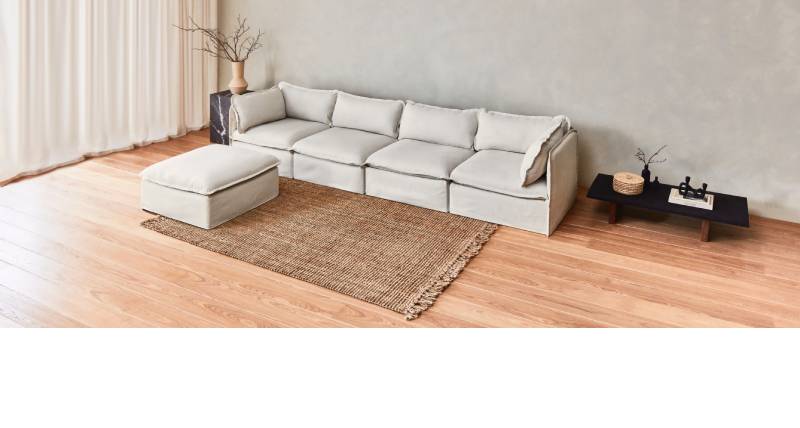
Modular Washable 5-Seater Corner Sectional + Ottoman in Willow | Memorix+ Seat | Contour Pillow
Main Uses of an Ottoman in Modern Homes
The ottoman started as a purely functional piece and has evolved into something that serves multiple purposes at once. In a modern home, it works as a footrest when lounging, extra seating when guests arrive, a tray surface for drinks or books, and in some configurations, hidden storage for blankets, remotes, and other everyday items. Part of the appeal is that it offers all this versatility while taking up little more space than a small chair.
Ottomans as Footrests: Comfort & Support
At its simplest, an ottoman invites you to put your feet up and unwind. When paired with an armchair, it extends the seat into a more complete lounging experience, enhancing both comfort and support. Anabei's chaise armchair pairs directly with an ottoman for exactly this purpose, full-length foot support designed for reading, watching, or just switching off.
The key to footrest use is getting the height right. An ottoman that sits at roughly the same height as the sofa or chair seat is the most comfortable. Too low and it strains the legs. Too high and it feels awkward.
Using Ottomans for Extra Seating
An ottoman works well as impromptu seating when more people need somewhere to sit. It is lower than a standard chair, but for casual gatherings, that rarely matters. Because it has no back or arms, it can be pulled in from any direction, which gives it more flexibility than a fixed chair in a crowded room.
Comparing a loveseat vs. a sofa situation, an ottoman often fills the gap. A loveseat seats two people comfortably. A sofa seats three or more. An ottoman in the room covers those extra guest moments without permanently committing to more furniture than the space needs day-to-day.

Photo by Janelle Lam - Modular Washable 5-Seater Corner Sectional + Ottoman in Sumi | Memorix+ Seat | Contour Pillow
Ottomans as Coffee Tables or Side Tables
A tray placed on an ottoman instantly converts it into a surface for drinks, books, or a laptop. It is softer than a traditional coffee table, which makes it a better choice for households with young children where hard edges are a concern. The height typically works well for this purpose when the ottoman is positioned in front of a sofa.
It does not replace a coffee table for every situation. If the priority is a completely stable, rigid surface, a proper table is still the better choice. But as a flexible alternative that also doubles as seating and a footrest, the ottoman wins on versatility.
Styling Tips: Choosing the Right Ottoman for Your Space
Matching the ottoman fabric to the sofa or armchair creates a cohesive look. Anabei's ottomans are available in the same performance fabric range as their sofas and armchairs, including options in Ash, Oat, Willow, Chestnut, Sumi, and Mist, among others, which makes matching straightforward.
A round ottoman softens a room with a lot of angular furniture. A rectangular ottoman works better in front of a sofa where the proportions need to align. Proportion matters. An ottoman that’s too small relative to the sofa can feel like an afterthought rather than an intentional part of the design.

Modular Washable 3-Seater Sectional in Ash | Memorix+ Seat | Contour Pillow
Best Rooms to Place an Ottoman
Living rooms are the most common placement, but ottomans work just as well in bedrooms at the foot of the bed, in reading corners paired with an armchair, in home offices as a second seating option, or on a larger covered porch or patio as casual outdoor seating.
In any room, the ottoman should be accessible without requiring someone to step around it. Leaving enough clearance around the piece, generally 18 inches between the ottoman and other furniture, keeps the layout feeling open rather than cramped.
FAQs
1. Can an ottoman be used as a coffee table?
Yes. A tray placed on top of an ottoman creates a stable surface for drinks, remotes, and other items. It works especially well in living rooms with young children, where a hard-edged coffee table is less ideal. The surface is softer, and the piece doubles as seating and a footrest, which gives it more versatility than a standard coffee table.
2. Are ottomans comfortable for extra seating?
They work well for casual, short-term seating. Because they have no back or arms, they are best suited to impromptu situations rather than extended sitting. For longer periods, a proper chair is more comfortable. That said, for gatherings and social situations, an ottoman pulled from a corner handles the overflow well.
3. What size ottoman should I choose?
Generally, an ottoman should be roughly two-thirds the width of the sofa it is paired with. For an armchair pairing, the ottoman should be close to the same width as the seat. Height should align with the seat of the sofa or chair for comfortable footrest use.
4. Where should I place an ottoman in my living room?
In front of the sofa is the most common placement, positioned so there is enough clearance to move around it comfortably. When paired with an armchair, it sits directly in front of that chair. It can also be used as a room centerpiece when styled with a tray, or pulled to the side when extra seating is needed.